Exempt No More: Nonprofit Entities Increasingly Targeted For Local Real Estate Taxes In Pennsylvania
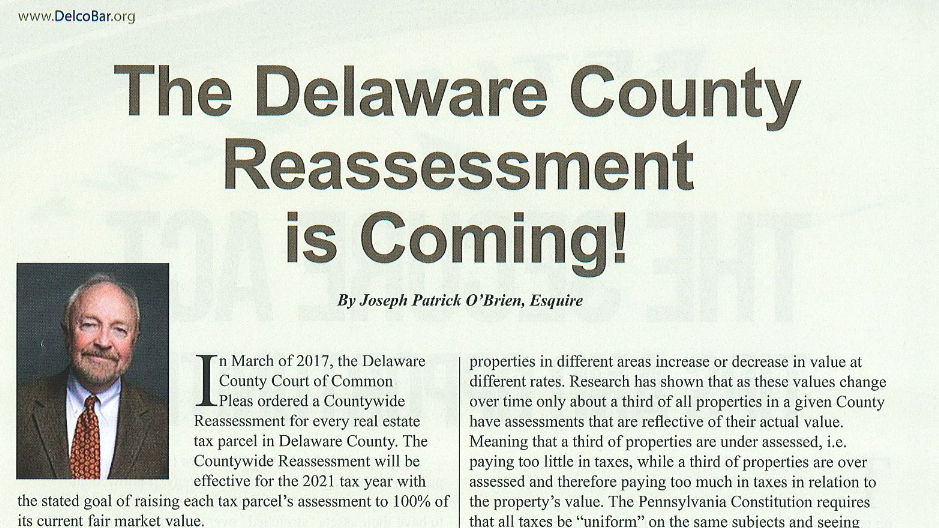
Delaware County made news last year when it announced it would be conducting a Countywide review of all tax-exempt real estate.

Over the next two years the County Assessor’s Office will determine whether some or all of these properties, primarily owned by nonprofit entities, warrant continued exemption from local real estate taxes.
The Chester County Court of Common Pleas seemingly piled on last October with its “Tower Health” decision ruling that three nonprofit Chester County hospitals are not tax exempt “charities” and ordered them to begin paying millions in annual local property taxes.
Lastly, assessment law changes over the last few years have spurred School Districts to begin challenging exemptions on a range of properties throughout their jurisdictions forcing nonprofits to expend financial resources in the fight to preserve tax exemptions.
These actions add up to an increasingly aggressive effort by municipalities, school districts, and counties across Pennsylvania in the never-ending hunt for new sources of tax revenue. Staying abreast of Pennsylvania’s exemption law can be the difference between securing a complete reduction in real estate taxes or a costly exemption fight.
Pennsylvania’s “Purely Public Charity” Legal Standard
While a PA nonprofit can seek exemption from federal income tax under section 501(c)(3) and its related sections of the Internal Revenue Code, that exemption does not extend to local real estate taxes on any real property. In Pennsylvania, a property owned by a nonprofit entity must qualify for exemption from real estate tax under a completely different legal standard. First, a nonprofit must prove it is a “purely public charity” under Article VIII, Section 2(a)(v) of the Pennsylvania Constitution. While the Constitution does not define “purely public charity”, the Pennsylvania Supreme Court in a 1985 decision set forth five criteria that became known as the “HUP Test”. Under the “HUP Test” a nonprofit entity must:
1. Advance a charitable purpose,
2. Donate or render gratuitously a substantial portion of its services,
3. Benefit a substantial and indefinite class of persons who are legitimate subjects of charity,
4. Relieve the government of some of its burden, and
5. Operate entirely free from profit motive.
Second, the nonprofit entity must satisfy five statutory requirements under the Institutions of Purely Public Charity Act under 10 P.S. §§371-385 (“Act 55”). Finally, a nonprofit entity must prove it qualifies for exemption under each County’s respective County Assessment Law.
Importantly, the exemption is limited to “only that portion of real property . . . which is actually and regularly used for the purposes of the institution” as vacant buildings are generally not entitled to tax exemption. It is therefore incumbent on nonprofit entities to keep close watch on how their properties are being utilized.
Payment in Lieu of Taxes
In order to forgo the risks and costs of litigation, many nonprofit entities have been entering into a payment in lieu of taxes agreement (“PILOT”) with the local taxing jurisdictions. PILOT agreements are voluntary agreements between the owner of the real estate and the political subdivision. Nonprofit entities, however, should beware of entering into misguided PILOT agreements which see their donor funds being spent on concerns outside of their charitable mission.
For those that work with or advise nonprofit entities, knowing how to safeguard against an exemption challenge and how to properly qualify for one is essential to protecting against the growing challenges nonprofit entities face in Pennsylvania’s local real estate tax environment.
Christopher Peifer, Esq. is a Partner with KAO Law Associates and practices in the fields of Real Estate and Tax Assessment Litigation.
*This Article Appeared in the Foundation for Delaware County's Professional Advisor Quarterly Newsletter